Labor Demand and Hiring Trends
Table 1 shows the labor market indicators according to the Russian Federal State Statistics Service data for August 2026. In Q3, the quarterly decline in unemployment stalled, and the year-over-year trend even reversed. In August, labor shortages persisted, as employer hiring demand continued to outpace employment growth, according to Adviros estimations.
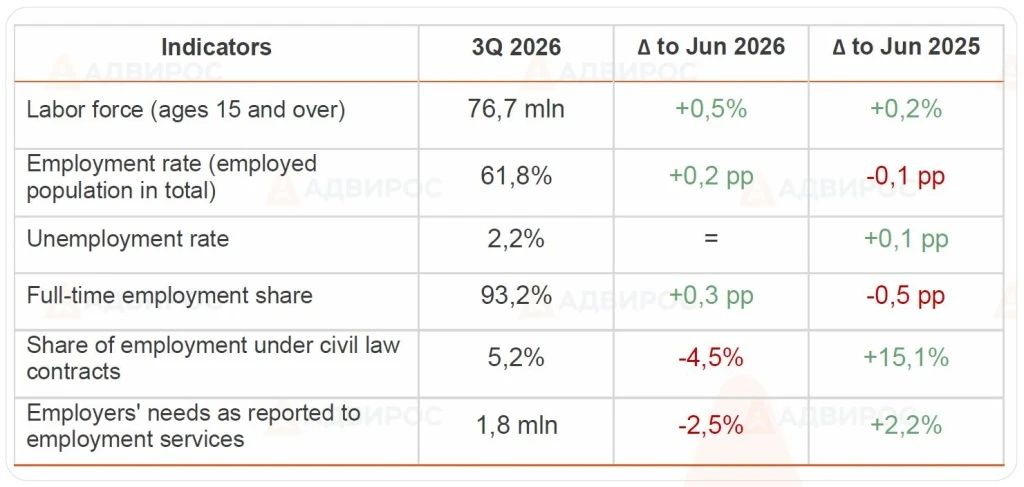
Table 1 Key characteristics of the Russian labor market in June and August 2026, Rosstat data
The share of employment under civil contracts fell by 3.5% over the quarter, with only a small portion likely being transferred to the staff.
In Q3 2026, the labor market experienced a pivot toward cooling demand for talent.
Employer hiring demand declined quarter-over-quarter for the first time in 2026, though year-over-year growth remains positive. This signals a demand correction rather than a collapse. Data from the “Rabota Rossii”
2 portal shows that the number of vacancies fell by 14% QoQ, while the number of organizations posting vacancies dropped by 9.4%. The average number of open positions per employer shrank from
15.7 to 12.9 (−17.5%). Consequently, a portion of companies halted vacancy postings altogether, while other scaled back their stated hiring needs. This trend aligns with monitoring data from the Bank of Russia, indicating that most enterprises do not plan to expand their headcount.
Overall, hiring intensity decreased in Q3. However, accumulated labor demand remains elevated, and the talent shortage has become increasingly selective.
The largest commercial job platforms corroborate the cooling of labor demand. In September 2026, job postings on hh.ru were 13% lower YoY
3, down 18% on Superjob
4, and down 28% on Avito Rabota
5. The labor market continued its shift toward increased applicant competition, though the pace of quarterly shifts remains notably slower than year-over-year trends. In September, the hh-index
6 stood at 8.5, up 2.4% QoQ. Similarly, Avito Rabota labor market competition index
7 remained flat at 9.8 for the quarter, while the overall volume of active resumes on these platforms continued to expand year-over-year. Employer selectivity in hiring is intensifying. Adviros reported a 12% QoQ increase in demand for niche talent search. Furthermore, according to Superjob, the share of employers willing to hire candidates with active criminal records dropped to 9% (down 8 pp YoY), while the proportion of existing full-time staff with such records fell to 5% (down 3 pp YoY)
8.
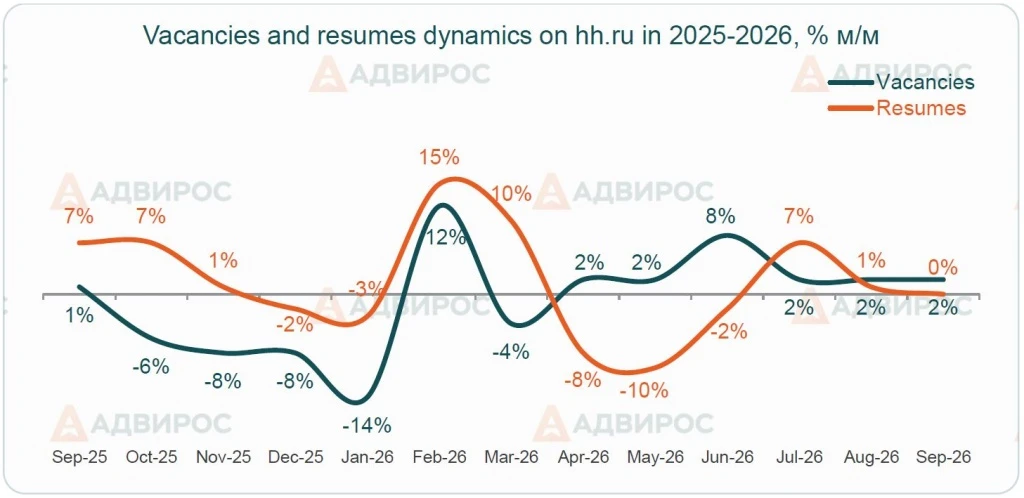
Fig. 1 Dynamics of vacancies and resumes on hh.ru in 2025–2026 in % month-on-month
Labor demand is cooling across both near-term and long-term horizons.
The composition of remaining job openings has shifted back toward traditional, regulated employment structures. On the Rabota Rossii portal, the share of standard 40-hour workweek postings rebounded from 78.1% in Q2 to 85.2% in Q3. The sole expanding segment was rotational work (remote-site assignments)
9 : hh.ru recorded a 29% QoQ surge in rotational postings, the fastest growth rate among all employment formats. Rabota Rossii portal corroborates this trend, noting a 0.2 pp increase in the rotational share, reaching 1.3%. Meanwhile, flexible work arrangements displayed divergent trends: part-time and supplementary gig postings grew 9% and 10% QoQ, respectively, while contingent project-based roles contracted by 12%.
Labor Supply and Candidates’ Behavior
In Q3 2026, labor market supply continued to expand. According to hh.ru, the volume of active resumes increased by 26% YoY, and by 32% on Superjob. The subjective difficulty of finding employment also intensified. Superjob data indicates that the job search difficulty rating among candidates rose from 6.5 to 7.3 out of 10
10. Furthermore, Rosstat reports that the share of Russians unable to secure employment for more than a year grew from 9.7% to 13.3%.
The expansion of the candidate pool is outpacing the growth of actual hiring opportunities, a shift felt most acutely by entry-level professionals. While lack of experience remains the top cited barrier for graduates (64%, +5 pp YoY), friction related to starting wage dissatisfaction and vacancy scarcity accelerated more rapidly (+11 pp YoY each).
Critically, Q3 marked a structural pivot in wage expectations: average desired salaries contracted 1.9% YoY to RUB 151K (median: −4.2% to RUB 114K)
11, representing the first YoY decline in 8 years and a sharp deceleration from the prior year’s 14% growth trajectory.
Concurrently, job seekers are demonstrating an increased willingness to make concessions during salary negotiations. According to Superjob, the average acceptable wage concession grew from 9.5% in January to 10.5% in August
12. Yet, concession thresholds remain tightly clustered: 24% of candidates cap their flexibility at a 10% reduction, and 16% at 5%. This suggests incremental market adaptation rather than a structural devaluation of labor. Notably, 36% of job seekers still categorically refuse to revise their compensation expectations.
The moderating wage expectations do not equate to diminished priority. Recent Russian Public Opinion Research Center polling confirms that competitive pay remains the paramount driver of employer brand attractiveness
13, with 94% of respondents citing compensation increases as the primary catalyst for voluntary turnover
14. Despite tightening labor market conditions, latent mobility remains robust: 74% of the workforce is receptive to superior offers, and 8% exhibit high mobility regardless of terms, driven primarily by dissatisfaction with current professional development trajectories. This mobility is increasingly gated by candidate due diligence. Between 74% and 81% of applicants conduct pre-application employer research (peaking among the 35–45 age cohort and top-income earners)
15, 40% of Russians are fundamentally unwilling to accept off-the-books compensation
16.
The increased availability of candidates doesn’t simplify the hiring process. Job seekers maintain high levels of selectivity, continuing to rigorously evaluate employer’s stability, transparency of employment terms, and long-term career prospects.
Want a deeper look at labor market trends and the Q4 outlook?
Request the full Q3 2026 analytical report.
Author: Ilona Platonova, Manager of the Business Analytics and Solutions Department at Adviros
Image:
Magnific
1 The Federal State Statistics Service in Russia, abbreviated as Rosstat, is the governmental statistics agency.
2 “Rabota Rossii” is a state job platform.
3 https://stats.hh.ru/
4 https://iz.ru/2175480/iana-chernikova/trud-v-riske-v-rossii-vakansii-stalo-na-35-menshe-reziume-na68-bolshe
5 https://www.avito.ru/employer/labor-market
6 hh-index is a ratio of the active resumes number to the active vacancies number on hh.ru.
https://stats.hh.ru/
7 The Labor Market Competition Index shows the ratio of job seekers to employers on the Avito Rabota platform: the higher the value, the more job seekers there are per employer.
https://www.avito.ru/employer/labor-market
8 https://superjob.ru/pro/7025/
9 This refers to extended on-site work schedules (e.g., 2 weeks on / 2 weeks off) in remote geographic locations, predominantly in extractive industries, energy, and large-scale infrastructure.
10 https://superjob.ru/pro/7103/
11 https://www.vedomosti.ru/economics/articles/2026/10/09/1235595-rossiyane-snizili-ozhidaniya-pozarplatam
12 https://www.superjob.ru/research/articles/115932/za-zarplatu-na-sobesedovanii-zhenschiny-torguyutsya-zhestche
13 https://wciom.ru/analytical-reviews/analiticheskii-obzor/luchshii-rabotodatel-strany-2026
14 https://superjob.ru/pro/7045/
15 https://www.superjob.ru/research/articles/115836/otzyvy-o-kompanii-izuchayut-7-iz-10-soiskatelej/
16 https://superjob.ru/pro/7020/
Back to list